Patient Education Common Cold
What is the common cold?
Common cold is an infection of the nose and throat
a.k.a upper respiratory tract infection (URTI).
caused by many types of viruses.
It is not influenza (the flu)
What are the symptoms?
The usual symptoms are:
runny or stuffy nose
sore throat
sneezing
sore eyes
feeling generally unwell
slight fever.
Other possible symptoms are:
headaches
hoarseness
high fever, with general aches and pains
coughing
swelling of lymph glands.
How did I get it?
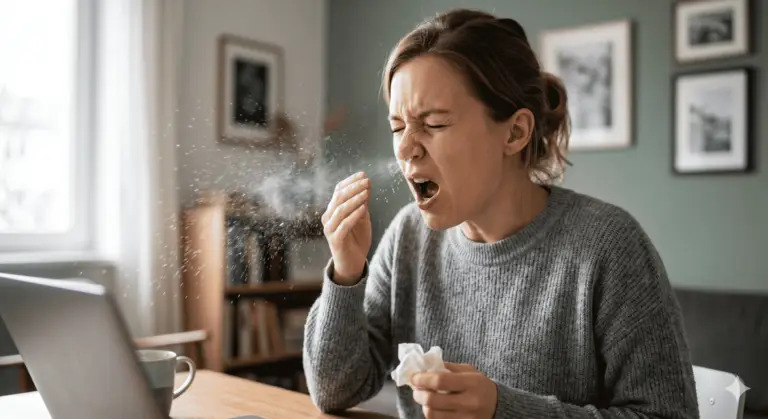
You must have breathed in the virus, which is carried in the air after being coughed or sneezed out by another person with a cold.
So, what is the treatment?
There is no cure for the common cold.
Antibiotics are of no use for viral infections and are only useful for certain complications.
Fortunately, the body’s immune system is able to fight the virus by making antibodies.
But it takes several days.
So what do i do if there is no treatment?
Rest.
It is important to have plenty of sleep and rest
Physical activity puts extra demands on the immune system
Drink lots of fluids—at least 2 litres a day
Painkillers have several useful effects:
Control fever and inflammation
Help ease the pain from the illness
Inhaling steam can help with blocked nose
Put boiled water into a basin
Put a towel over your head
Inhale steam from your nose and exhale through your mouth
Children should not try this due to risk of burns.
If you have a dry cough, you may suppress it with certain medicine.
Ask your pharmacist or doctor about this
Gargling warm water or lemon juice can soothe a sore throat in adults
What else should I know?
Your cold may clear up in a few days, but can last up to 10 days.
Sometimes you can get a bacterial complication, which may require antibiotics.
Antibiotics are not prescribed as a rule because they are not necessary.
Viruses are not destroyed by the commonly prescribed antibiotics and giving them do not leads to a quicker recovery.
If you get any of the following, you should see the doctor:
a sore ear
chest pain
difficulty in breathing
a lot of green mucus from your chest or nose
How can it be prevented?
Your immunity is all you need!
Falling sick too much?
Time to rethink your lifestyle 😬
Key points to remember
There is no cure for the common cold but symptoms can be relieved.
Most people recover in about 7 days
Avoid antibiotics
References
Heikkinen T, Järvinen A. “The common cold.” The Lancet. 2003. A highly cited review covering causes, viral transmission, symptoms, natural history, and why the common cold is distinct from influenza. Useful as the main background reference.
Pappas DE. “The Common Cold.” Principles and Practice of Pediatric Infectious Diseases. 2017. Good reference for common cold definition, rhinovirus as a major cause, symptoms in children and adults, and expected clinical course.
Eccles R. “Common Cold.” Frontiers in Allergy. 2023. Recent peer-reviewed review explaining the common cold as a human viral upper respiratory illness, including symptom mechanisms and common causative viruses.
Allan GM, Arroll B. “Prevention and treatment of the common cold: making sense of the evidence.” CMAJ. 2014. Excellent practical evidence review for prevention and symptom-relief measures. Supports handwashing, symptom-directed care, and the limited role of many treatments.
Kenealy T, Arroll B. “Antibiotics for the common cold and acute purulent rhinitis.” Cochrane Database of Systematic Reviews. Updated 2025. Strong evidence that antibiotics do not benefit uncomplicated common cold or acute purulent rhinitis and may cause adverse effects. Best citation for the “avoid antibiotics” section.
Singh M, Singh M. “Heated, humidified air for the common cold.” Cochrane Database of Systematic Reviews. 2017. Systematic review showing insufficient evidence to support routine steam inhalation for common cold symptoms. Also relevant because steam over hot water has burn risk, especially in children.
Malesker MA, et al. “Pharmacologic and nonpharmacologic treatment for acute cough associated with the common cold.” CHEST. 2017. Useful for the cough section. Reviews evidence for cough medicines and non-drug measures in adults and children with common-cold-related cough.
Choi IK, et al. “A comparison of the efficacy and safety of non-steroidal anti-inflammatory drugs versus acetaminophen in symptom relief for the common cold: a meta-analysis of randomized controlled trial studies.” Korean Journal of Family Medicine. 2013. Useful citation for paracetamol/acetaminophen and NSAIDs as symptomatic treatment for fever and pain in common cold.
Moncion K, et al. “Effectiveness of hand hygiene practices in preventing influenza virus infection in the community setting: a systematic review.” Influenza and Other Respiratory Viruses. 2019. While focused on influenza, it supports the broader prevention section on respiratory virus spread and hand hygiene.
Aiello AE, et al. “Effect of hand hygiene on infectious disease risk in the community setting: a meta-analysis.” American Journal of Public Health. 2008. Strong community-level prevention reference showing hand hygiene reduces respiratory illness risk.
Cohen S, et al. “Sleep habits and susceptibility to the common cold.” Archives of Internal Medicine. 2009. Useful for the prevention/lifestyle section. Shows poorer sleep efficiency and shorter sleep are associated with higher susceptibility to experimentally induced common cold.
Nieman DC. “Physical activity lowers the risk for acute respiratory infections.” Journal of Sport and Health Science. 2022. Supports the article’s advice on regular exercise and immune health, especially for reducing acute respiratory infection risk.
Wat D. “The common cold: a review of the literature.” European Journal of Internal Medicine. 2004. Useful background review covering common cold symptoms, virology, and distinction from other respiratory infections b